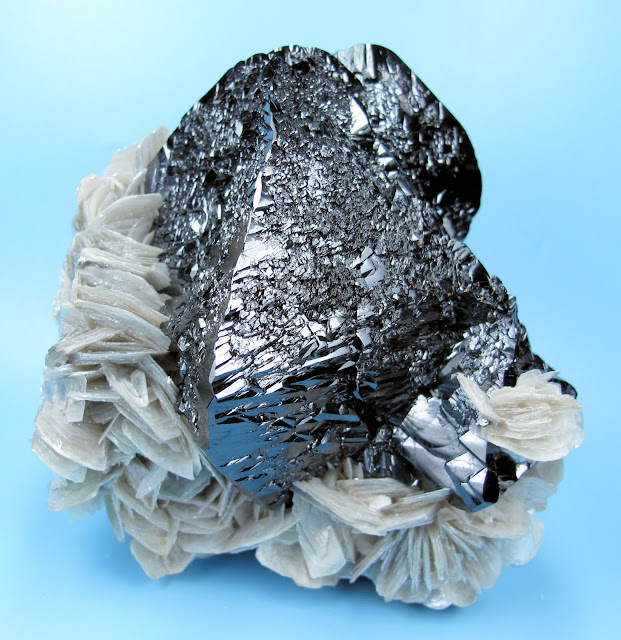
Barite is a mineral composed of barium sulfate (BaSO4). It receives its name from the Greek word "barys" which means "heavy." This name is in response to barite's high specific gravity of 4.5, which is exceptional for a nonmetallic mineral. Density: 4.48 g/cm³ Optical properties: biaxial positive Crystal class: Dipyramidal (mmm); H-M symbol: (2/m 2/m 2/m) Crystal habit: Tabular parallel to base, fibrous, nodular to massive Specific gravity: 4.3–5
Posts
Praseodymium is a soft, silvery, malleable and ductile metal, valued for its magnetic, electrical, chemical, and optical properties. It is too reactive to be found in native form, and pure praseodymium metal slowly develops a green oxide coating when exposed to air. Symbol: Pr Electron configuration: [Xe] 4f36s2 Atomic number: 59 Atomic mass: 140.90765 u Discovered: 1885
Gold is a chemical element with the symbol Au (from Latin: aurum) and atomic number 79, making it one of the higher atomic number elements that occur naturally. In its purest form, it is a bright, slightly reddish yellow, dense, soft, malleable, and ductile metal. Chemically, gold is a transition metal and a group 11 element. It is one of the least reactive chemical elements and is solid under standard conditions. Gold often occurs in free elemental (native) form, as nuggets or grains, in rocks, in veins, and in alluvial deposits. It occurs in a solid solution series with the native element silver (as electrum) and also naturally alloyed with copper and palladium. Less commonly, it occurs in minerals as gold compounds, often with tellurium (gold tellurides).
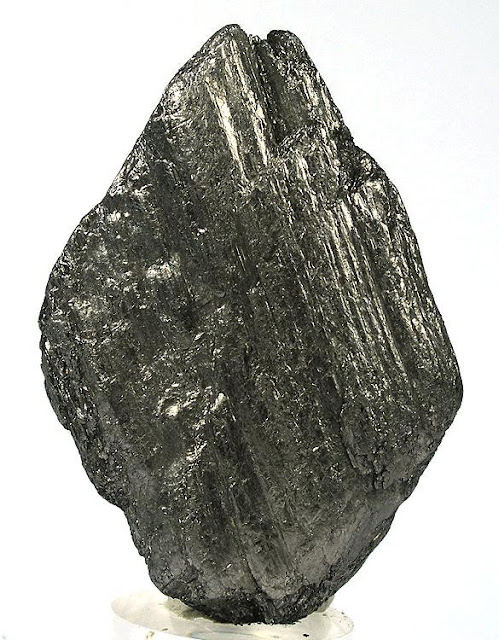
Graphite, archaically referred to as plumbago, is a crystalline form of the element carbon with its atoms arranged in a hexagonal structure. It occurs naturally in this form and is the most stable form of carbon under standard conditions. Under high pressures and temperatures it converts to diamond. Density: 2.09–2.23 g/cm3 Mohs scale hardness: 1–2 Optical properties: Uniaxial (–) Crystal system: Hexagonal Space group: P63mc (buckled) P63/mmc (flat) Crystal habit: Tabular, six-sided foliated masses, granular to compacted masses
Thorium is a weakly radioactive metallic chemical element with the symbol Th and atomic number 90. Thorium is silvery and tarnishes black when it is exposed to air, forming thorium dioxide; it is moderately hard, malleable, and has a high melting point. Symbol: Th Electron configuration: [Rn] 6d27s2 Atomic number: 90 Atomic mass: 232.03806 u Discoverer: Jöns Jacob Berzelius
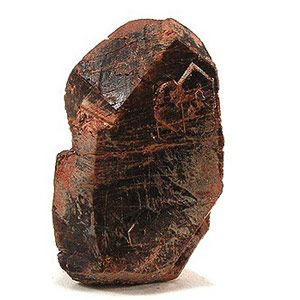
Wolframite, WO₄, is an iron manganese tungstate mineral that is the intermediate between ferberite and hübnerite. Along with scheelite, the wolframite series are the most important tungsten ore minerals. Wolframite is found in quartz veins and pegmatites associated with granitic intrusives. Crystal class: Prismatic (2/m); (same H-M symbol) Crystal system: Monoclinic crystal system Crystal habit: Tabular to short prismatic crystals Space group: P2/c Streak: Reddish brown Color: Grayish to brownish black
Cobalt is a chemical element with the symbol Co and atomic number 27. Like nickel, cobalt is found in the Earth's crust only in chemically combined form, save for small deposits found in alloys of natural meteoric iron. The free element, produced by reductive smelting, is a hard, lustrous, silver-gray metal.
Cassiterite is a tin oxide mineral, SnO₂. It is generally opaque, but it is translucent in thin crystals. Its luster and multiple crystal faces produce a desirable gem. Cassiterite has been the chief tin ore throughout ancient history and remains the most important source of tin today. Crystal system: Tetragonal crystal system Crystal class: Ditetragonal dipyramidal (4/mmm); H-M symbol: (4/m 2/m 2/m) Optical properties: Uniaxial (+) Mohs scale hardness: 6–7 Unit cell: a = 4.7382(4) Å, c = 3.1871(1) Å; Z = 2 Did you know: Cassiterite sometimes is used as a minor gemstone, but mostly for the collectors of minerals.
A mineral ore is any mineral that has a sufficient amount of the value element or compound that it can be economically mined. Below is a list of all Mineral ore Frume Hi-Tech Mines: LEAD ORE ZINC ORE COPPER ORE PLATINUM ORE NICKLE ORE LITHIUM ORE TITANIUM ORE (40% ABOVE) PALLADIUM ORE RHODIUM ORE TRIDIUM ORE IRON ORE FINS (SOFT IRON)
Columbite, also called niobite, niobite-tantalite and columbate [Nb₂O₆], is a black mineral group that is an ore of niobium. It has a submetallic luster and a high density and is a niobate of iron and manganese. This mineral group was first found in Haddam, Connecticut, in the United States. Color: Black, brownish black Crystal system: Orthorhombic crystal system Crystal class: Dipyramidal (mmm); H-M symbol: (2/m 2/m 2/m) Optical properties: Biaxial (+), b=2.29–2.4 Space group: Pbcn Other characteristics: non-radioactive, non-fluorescent
The mineral group tantalite [Ta₂O₆] is the primary source of the chemical element tantalum. It is chemically similar to columbite, and the two are often grouped together as a semi-singular mineral called coltan or "columbite-tantalite" in many mineral guides. Crystal class: Dipyramidal (mmm); H-M symbol: (2/m 2/m 2/m) Crystal system: Orthorhombic crystal system Mohs scale hardness: 6-6.5 Strunz classification: 4.DB.35 Cleavage: Good in one direction Specific gravity: 8.0+
Amethyst is a violet variety of quartz. The name comes from the Koine Greek ἀμέθυστος amethystos from ἀ- a-, "not" and μεθύσκω methysko / μεθύω methyo, "intoxicate", a reference to the belief that the stone protected its owner from drunkenness. Color: Purple Luster: Vitreous Birthstone zodiac sign: Aquarius Associated month: February Crystal system: Hexagonal crystal system Chemical formula: SiO₂
Garnets are a group of silicate minerals that have been used since the Bronze Age as gemstones and abrasives. All species of garnets possess similar physical properties and crystal forms, but differ in chemical composition. The different species are pyrope, almandine, spessartine, grossular, uvarovite and andradite. Mohs scale hardness: 6.5–7.5 Crystal habit: Rhombic dodecahedron or cubic Crystal system: Isometric Optical properties: Single refractive, often anomalous double refractive Space group: Ia3d Color: RED, GREEN Other characteristics: variable magnetic attraction
Zircon is a mineral belonging to the group of nesosilicates. Its chemical name is zirconium silicate, and its corresponding chemical formula is ZrSiO₄. Color: Blue, White, Green, Red, Yellow, Grey, Purple, Pink, Orange, Brown Luster: Adamantine Associated month: December Crystal system: Tetragonal crystal system Chemical formula: ZrSiO₄ Hardness (Mohs hardness scale): 7.5
Aquamarine is a color that is a light bluish tint of green that is in-between cyan and spring green on the color wheel. It is named after the mineral aquamarine, a gemstone mainly found in granite rocks. The first recorded use of aquamarine as a color name in English was in 1598 AquaMarine is available in different colours I. Blue Colour II. Green Colour III. Yellow Colour Helidor
Emerald is a gemstone and a variety of the mineral beryl colored green by trace amounts of chromium and sometimes vanadium. Beryl has a hardness of 7.5–8 on the Mohs scale. Most emeralds are highly included, so their toughness is classified as generally poor. Emerald is a cyclosilicate. Color: Green Luster: Vitreous Birthstone zodiac sign: Taurus Associated month: May Crystal system: Hexagonal crystal system Chemical formula: Be₃Al₂SiO₆